Bills Waste: Recycling and Sustainability Commitments
Bills Waste is committed to a future where waste is a resource. Our sustainability page outlines measurable goals, local infrastructure, community partnerships and practical action across boroughs. We champion prevention, reuse and recycling, and we work alongside residents, businesses and local authorities to reduce the carbon footprint of waste services.
Our headline target is clear: a minimum recycling percentage target of 70% municipal waste by 2030. This ambition is supported by staged milestones ??? 55% by 2026 and 63% by 2028 ??? and a monitoring framework that includes regular audits of kerbside collections, communal recycling points and transfer station performance. Achieving these figures requires coordination with borough collection schemes and continuous improvements to sorting and processing.
Local Transfer Stations and Efficient Logistics
BillsWaste operates through a network of local transfer stations and consolidation hubs close to the communities we serve. These transfer stations reduce haul distances, lower emissions and speed the flow of separated materials to specialist processors. By routing materials through nearby facilities we minimise double handling and retain more value in recyclable streams.
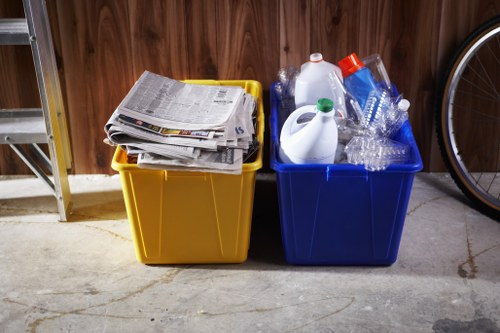
Across many boroughs, kerbside schemes separate food waste, glass, paper and mixed recycling into distinct streams. Our transfer stations are configured to accept segregated loads and to carry out secondary sorting when necessary. This localised approach supports circular outcomes for:
- paper and card collections for pulping and repapering
- glass cullet recovery for container and aggregate use
- organic/food waste conversion to compost or anaerobic digestion
- bulky items and small electricals directed to reuse and recycling channels
Partnerships with Charities and Social Reuse
Our reuse-first strategy means we actively partner with local charities and social enterprises. Bill's Waste works with community reuse centres, furniture charities and clothing redistribution networks to keep items in circulation. Items that are serviceable are diverted from the recycling line and given to organisations that support vulnerable households and employment training schemes.
The partnership model supports a resource recovery economy rather than a linear disposal model. Through coordinated collection streams from bulky waste pickups and community donation points, we ensure that:
- working furniture and appliances are refurbished and redistributed
- textiles are sorted for reuse before recycling
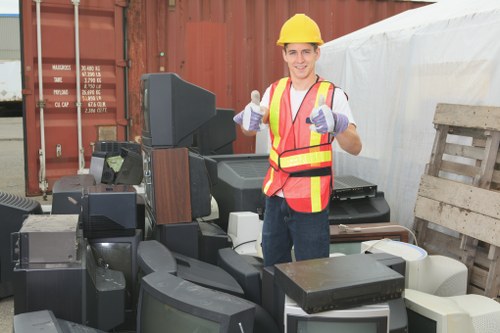
- small electricals are checked and repaired where possible, or sent to certified WEEE processors
Low-Carbon Vans and Fleet Decarbonisation
![A large stack of wooden pallets is arranged outdoors on a paved surface, with the pallets positioned in multiple layers, some leaning slightly to the side. The pallets are made of light-colored, untreated timber with visible grain and rough texture, featuring slats and supporting beams that form rectangular platforms. Surrounding the pallets are other discarded wooden items, including smaller pallets and planks, some weathered with darker patches and signs of use. To the left, part of a weathered wooden bench with a dark finish and some wear patterns is visible, partially obscured by the pallets. In the background, there is a low brick wall and a chain-link fence with some metal framing, suggesting an industrial or waste management yard setting. The overall scene indicates a safe, organized space for rubbish or waste timber storage, consistent with a professional waste removal service such as Bills Waste, operating in the vicinity of [POSTCODE] or [TOWN], in line with their recycling and sustainability services.](/pub/_photos/rubbish/f1486209024.jpg) Decarbonising transport is central to Bills Waste environmental policy. Our fleet strategy prioritises low-emission vehicles: battery electric vans for urban collection rounds, plug-in hybrids for medium-distance transfers and efficient Euro-6 alternatives where electrification is not yet feasible. We are already operating a growing number of low-carbon vans and plan a full transition to zero-tailpipe-emission vehicles for urban rounds by 2028.
Decarbonising transport is central to Bills Waste environmental policy. Our fleet strategy prioritises low-emission vehicles: battery electric vans for urban collection rounds, plug-in hybrids for medium-distance transfers and efficient Euro-6 alternatives where electrification is not yet feasible. We are already operating a growing number of low-carbon vans and plan a full transition to zero-tailpipe-emission vehicles for urban rounds by 2028.
![A cluttered indoor scene featuring a large pile of mixed household laundry, including various fabrics such as clothing, towels, and bed linens, with some items draped over a plastic laundry basket and others stacked on cardboard boxes. The textiles display different textures, from soft cotton to thicker wool fabrics, and come in a range of colours including beige, brown, red, pink, and purple. Nearby, a pair of white sneakers and a plastic-wrapped item are visible among the mess. The background suggests an interior space, possibly a bedroom or storage area, with the pile extending across a wooden floor and partially blocking a glimpse of a wall. The overall scene depicts a disorganized area that could require rubbish removal or cleaning, consistent with services offered by companies such as Bills Waste, particularly for residential or domestic items that need clearing or disposal, especially in the context of recycling and sustainability efforts in the local area around [POSTCODE].](/pub/_photos/rubbish/f1375042880.jpg)
Operational changes complement vehicle upgrades. Route optimisation software, consolidated deliveries to transfer stations, and staff training in eco-driving reduce fuel consumption and emissions. We also trial charging infrastructure at depot sites and examine emerging technologies such as hydrogen fuel-cell vehicles for longer-range tasks.
By combining greener vehicles with smarter logistics and local transfer stations, Bills Waste lowers CO2 and NOx emissions while improving service reliability.
How boroughs' waste separation affects outcomes: Different boroughs apply slightly different kerbside rules ??? some use separate glass boxes, others combine glass with mixed recycling; some run weekly food waste collections while others use communal organic bins. Bills Waste adapts to these local systems, delivering tailored collection containers, public education support and sorting capacity at transfer stations so that separated materials remain clean and marketable.
Community engagement remains essential. We run educational campaigns (in partnership with councils) that emphasise what goes in each bin, highlight common contamination mistakes and promote reuse options. Our messages include practical tips for residents to maximise recycling rates, reduce contamination and support the 70% recycling ambition.
At Bills Waste we measure success by tonnes diverted from landfill, increased reuse rates through charity partnerships, reduced vehicle emissions and the steady progress toward our recycling percentage target. We are committed to transparency and continuous improvement, working with boroughs, local transfer stations, charities and residents to build a resilient, low-carbon waste management system.